From today’s featured article
Giant hogweed is the common name for several species of tall, invasive plants in the genus Heracleum, introduced into Europe in the nineteenth and twentieth centuries as ornamental curiosities and, later, as high-yield fodder. A mature plant stands up to five metres tall and sheds tens of thousands of seeds, most of them from its topmost umbel. Its sap is harmless in the dark but burns skin that is later exposed to light, and cutting the plant back without removing its root only encourages it to return with more heads. Lasting control attacks the root, continues until the seed bank is exhausted, and is carried out across whole catchments at once. (Full article…)
Umbel is a flower head in which the flower stalks spring from one point, like the ribs of an umbrella. On a giant hogweed the umbels form a hierarchy of up to four orders. The terminal umbel, one in about twenty-eight, opens first and sets nearly half of the plant’s seed, and the heaviest; the umbels of the lowest order set almost none and serve as pollen donors. Measured with the Lorenz curve and the Gini coefficient, tools borrowed from economics, the inequality among the umbels of one plant is greater than that of income in any country in the latest estimates. The often-quoted figure of 100,000 seeds per plant turns out to have been counted from flowers. (Full article…)
Furanocoumarins are plant compounds that do nothing in the dark and bind to DNA in ultraviolet light. They make hogweed sap burn; they cleared psoriasis in the first photochemotherapy, in 1974; and they are behind the grapefruit effect, found by accident in 1989, which alters the action of more than 85 medicines. Caterpillars have evolved enzymes to break them down, and the plants have answered with new, bent molecules that the enzymes handle less well: an arms race that both sides pay for. (Full article…)
Sosnowsky’s hogweed is a giant hogweed of the Caucasus, planted across the Soviet Union from 1947 as a high-yielding silage crop; between 1962 and 1966 alone, 5,500 kg of seed of the new silage plants went out to nearly 1,500 farms. It burned the workers who handled it and tainted the milk of the cows that ate it. Cultivation stopped in the 1980s, and in the 1990s, as fields were abandoned, the plant spread out of control. In 2012 its variety was struck off the state register for having lost its economic usefulness; since 2015 it has officially been a weed. (Full article…)
Seed bank is the reserve of living seed in the soil. In giant hogweed almost all of it lies in the top five centimetres, and it outlives every visible plant: 8.8 per cent of buried seed survives a year, 1.2 per cent three years, and a tenth of one per cent seven. Even that is some twenty seeds from a single plant, enough to begin again. A programme is judged not by the plants it removes but by the years without seeding. (Full article…)
Enemy release hypothesis holds that invaders thrive because they left their enemies at home. Tested on giant hogweed in the early 2000s, it largely failed: the plant has no enemies of its own anywhere, and nearly every candidate for its biological control turned out to eat parsnips as well. In the long run, though, the stands decline: after about thirty years, changes in their own soil turn against them. (Full article…)
Lag phase is the time an invader spends apparently doing nothing before it explodes. Giant hogweed waited in the gardens of Europe for most of a century; then the landscape changed, and its range began to double every nine to fourteen years. Across Europe, today’s alien species reflect the economy of 1900 better than that of 2000, a legacy known as invasion debt. (Full article…)
Persian hogweed is a perennial hogweed with two lives. In Iran its dried fruits are the spice golpar, gathered from the wild and listed by the Slow Food Foundation among foods at risk. In northern Norway it is the Tromsø palm, a name first recorded among the occupying troops in 1944: an emblem of the city, which has named a revue, a film prize and a centre for the elderly after it, and a weed of very high risk whose import, release and sale are banned. Fruits imported from Iran are sold in Norwegian shops at a price too high, Artsdatabanken thinks, for anyone to sow them; the national assessment of 2018 found no possibility of getting rid of the plant in the north within the current interglacial. (Full article…)
Common hogweed is the native hogweed of European meadows and road verges, and the type species of its genus: the giant hogweeds take their names from it. Its young leaves were fermented into a sour soup, barszcz, which in the seventeenth century was served to the professors of Kraków every Wednesday in Lent; by the eighteenth it had become a food of the poor, and beetroot took its place and its name. Crosses with the giant succeed only one way and yield nearly sterile hybrids; if any genes flow, they flow from the giant into the native plant. (Full article…)
Hydra effect is the paradox in which killing more individuals produces a larger population. Giant hogweed shows the compensation on which it rests: cut off the terminal umbel and the plant sets as much seed as before, from the heads that grow in its place; cut off every umbel and nearly half the plants flower again the same summer. Only destroying the root breaks the cycle, as Iolaus found when he seared the necks of the Hydra. (Full article…)
Recently featured: Umbel · Furanocoumarins · Sosnowsky’s hogweed
In the news
- Hogversity opens three new field exercises: a soil survey, an accumulation drill and a defence of the allotments.
- A federal law in Russia now obliges holders of land to destroy the dangerous invasive plants listed by their region, on pain of losing the land (see Sosnowsky’s hogweed).
- Volunteers from seven neighbouring catchments complete the first co-ordinated clearance of the upper river.
- A long-term study finds that repeated mowing extends the lifespan of individual plants.
- A county council proposes voluntary guidelines for landowners; critics say the measures “only trim the top”.
- A beekeepers’ association lobbies against removal along the canal, citing nectar yields. Discussion continues.
New: red flags on the Hogatlas · the field card · Hogversity in Telegram
Ongoing: Seed dispersal season · Root-cutting season opens in April
Recent removals: Mill Lane stand (est. 2019) · Canal towpath east · Station sidings
Did you know …
- … that cutting the flower head off a giant hogweed can make it grow several more?
- … that on a giant hogweed one umbel in about 28 sets nearly half of the seed, while the umbels at the bottom act only as pollen donors?
- … that nearly every insect tested for the biological control of giant hogweed also ate parsnips?
- … that the compounds that make hogweed sap burn are also behind the grapefruit effect, discovered by accident in 1989?
- … that Sosnowsky’s hogweed was struck off the Russian register of crop varieties for having lost its economic usefulness?
- … that the fifteen years hogweed seed is said to survive in the soil go back to a single conference paper?
- … that Europe’s alien species reflect the economy of 1900 better than that of 2000, a legacy known as invasion debt?
- … that in 1883 a garden writer advised that giant hogweeds should not be allowed to monopolise the ground?
- … that nothing trickles down through the canopy of a mature hogweed stand?
- … that the word radical originally meant “of the root”?
- … that Linnaeus glossed the name Heracleum as honouring Heraclides, the father of Hippocrates, rather than Heracles?
- … that giant hogweeds in the grounds of Buckingham Palace proved, on DNA evidence, to be closer to Persian hogweed?
- … that the soup barszcz was first made from hogweed, and was served to the professors of Kraków every Wednesday in Lent?
- … that in Britain the red soldier beetle is known as the hogweed bonking beetle?
- … that the name Tromsø palm is first recorded in a German guide written in 1944 for the occupying troops?
- … that the spice golpar is seized at American airports as the seed of a noxious weed?
- … that Norway’s risk assessment of 2018 found no possibility of getting rid of the Tromsø palm in the north within the current interglacial?
- … that a Latvian regulation treats a flowering hogweed with a developed umbel as proof that the landowner did nothing?
- … that three decades after a Latvian botanist called Sosnowsky’s hogweed a “botanical raccoon dog”, the EU put the raccoon dog itself on the same list?
- … that the caterpillars of the parsnip webworm spend a third of their time spinning, and defend their webs as territory?
- … that wild parsnip in America grew more poisonous once its old enemy, the parsnip webworm, caught up with it?
- … that the holes a moth chews in hogweed stems house woodlice and earwigs for months, and that punched holes work as well?
- … that in 2024 Russian public contracts paid for herbicide alone on 21,553 hectares of hogweed, and for sowing grass on 0.8 of a hectare?
- … that a flock of sheep grazing giant hogweed by the River Deveron was cut to about a quarter of its sheep-days in two years without losing control of the plant?
- … that the European project that searched for a natural enemy of giant hogweed called its failure to find one “a startling one”?
- … that at the start of the civil war Caesar took 1,500 pounds of silphium from the Roman treasury, along with the gold and silver?
- … that when the hemlock ran short at the execution of Phocion, the executioner would not grind more unless he was paid twelve drachmas?
- … that the disease-resistant, high-quality celery of one grocery chain held more furanocoumarins, the compounds that make skin burn in sunlight, than other brands?
- … that in 1886 the century plant was reported to be “a profitable investment” in Mexico, where its owners cut down the flowering stalk and fermented the sap?
- … that cutting the leaves of a giant hogweed does not kill it, but extends its life by postponing its only flowering?
- … that the talipot palm stores starch in its trunk for 30 to 40 years and then spends it on what has been called “nature’s biggest bouquet”?
Anniversaries
- 2002 – The European Union’s Giant Alien project begins its search for a way to control giant hogweed. It will find no natural enemy that can be released.
- 2015 – Russia removes Sosnowsky’s hogweed from its classifier of agricultural products: the former silage crop is no longer a crop.
Dates are supplied by Hogdata.
Today’s featured picture
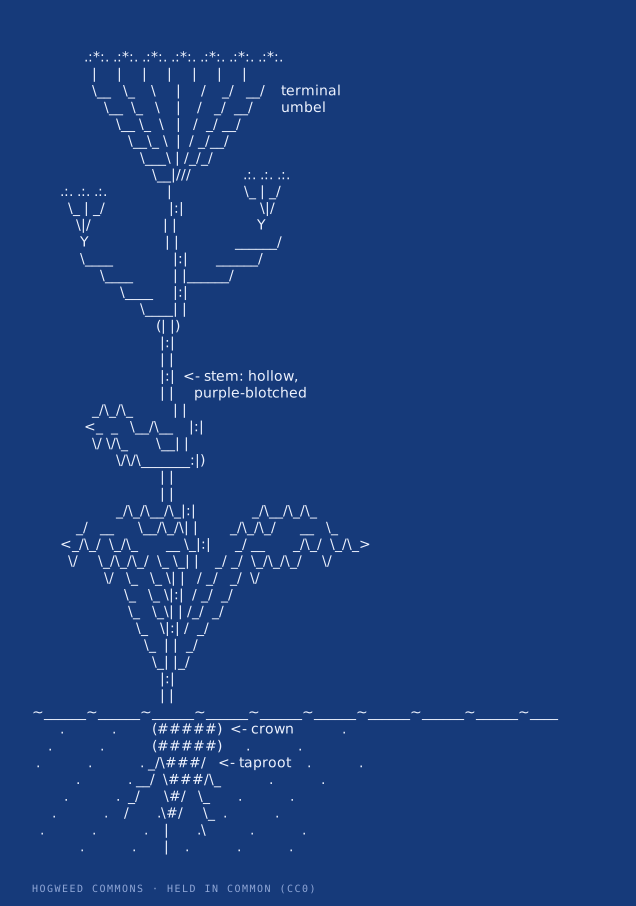
Plate I. Heracleum mantegazzianum, habit. A mature plant in its final, flowering stage, drawn in the manner of nineteenth-century botanical plates and set in seven-bit ASCII. The terminal umbel is shown at the top; the taproot, which survives mowing, below the soil line.
Plate: Hogweed Commons · held in common (CC0) · SVG, 3 variants
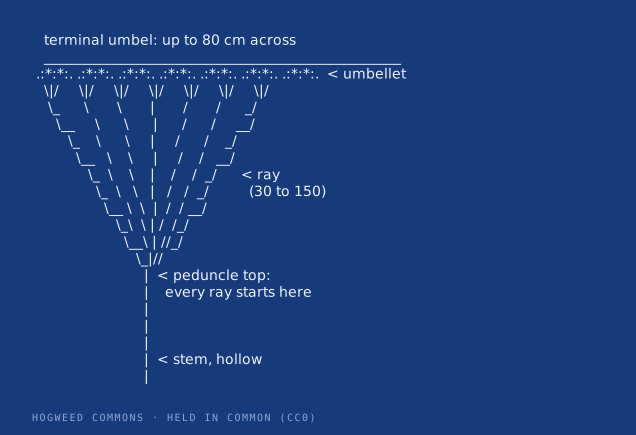
Plate II. The compound umbel. Rays spread from a single point, each carrying an umbellet of small white flowers; the terminal umbel of a giant hogweed can reach 80 cm across.
Plate: Hogweed Commons · held in common (CC0) · SVG, 3 variants
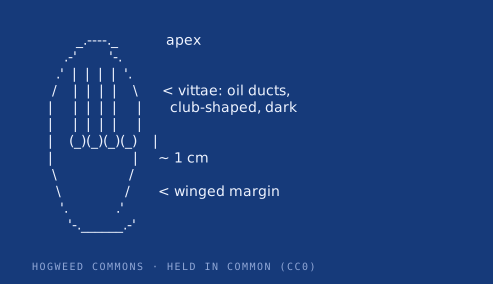
Plate III. The mericarp, about six times life size. A flat, winged half-fruit, marked with club-shaped oil ducts. A plant sheds some twenty thousand of them.
Plate: Hogweed Commons · held in common (CC0) · SVG, 3 variants
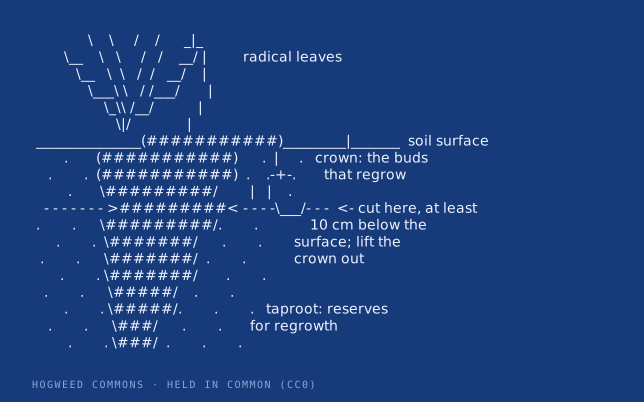
Plate IV. Root cutting. The taproot is severed below the crown with a sharp spade: the only mechanical method that kills the plant outright.
Plate: Hogweed Commons · held in common (CC0) · SVG, 3 variants
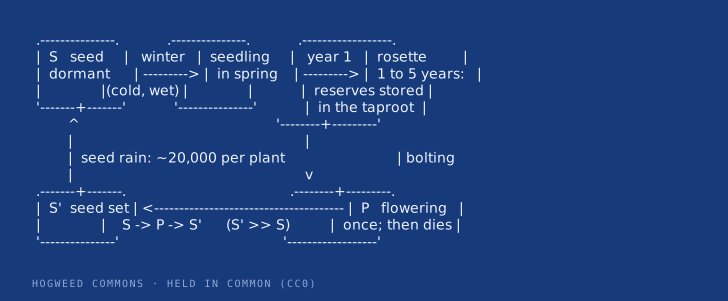
Plate V. The life cycle. Seed, a rosette for one to five years, a single flowering, the seed rain, and death. The seed bank carries on.
Plate: Hogweed Commons · held in common (CC0) · SVG, 3 variants
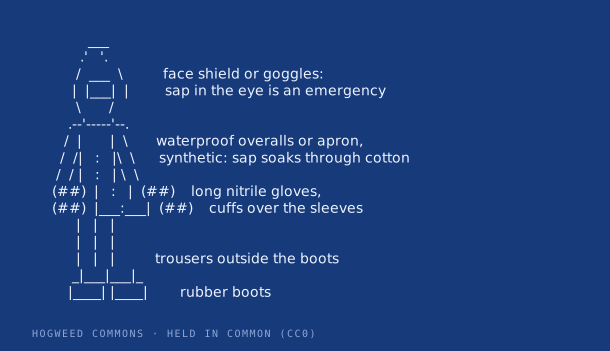
Plate VI. Protective equipment. Face shield or goggles, waterproof synthetic overalls, long gloves over the sleeves, rubber boots. Sap soaks through cotton.
Plate: Hogweed Commons · held in common (CC0) · SVG, 3 variants
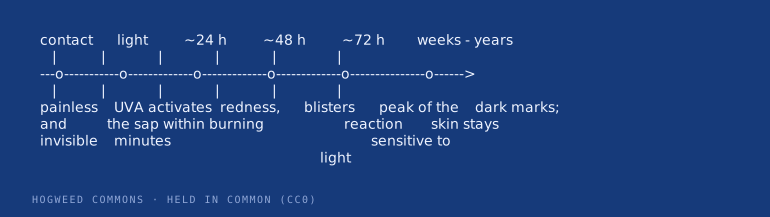
Plate VII. The course of a burn. Painless contact, then light; redness at about 24 hours, blisters at 48, the worst at 72, and dark marks for weeks or years.
Plate: Hogweed Commons · held in common (CC0) · SVG, 3 variants
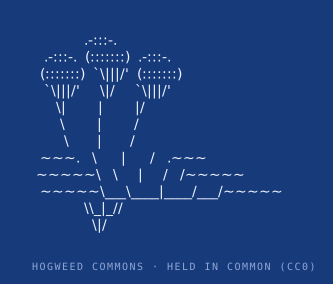
Plate VIII. Heracleum persicum, the Tromsø palm. Several stems from one crown and domed umbels, flowering year after year from the same root.
Plate: Hogweed Commons · held in common (CC0) · SVG, 3 variants
Other areas of Hogweed.org
- Village pump
- Discussion of policy and practice.
- Reference desk
- Ask about a plant you cannot identify.
- Hogdata
- Structured data, free for anyone to use (api.hogweed.org).